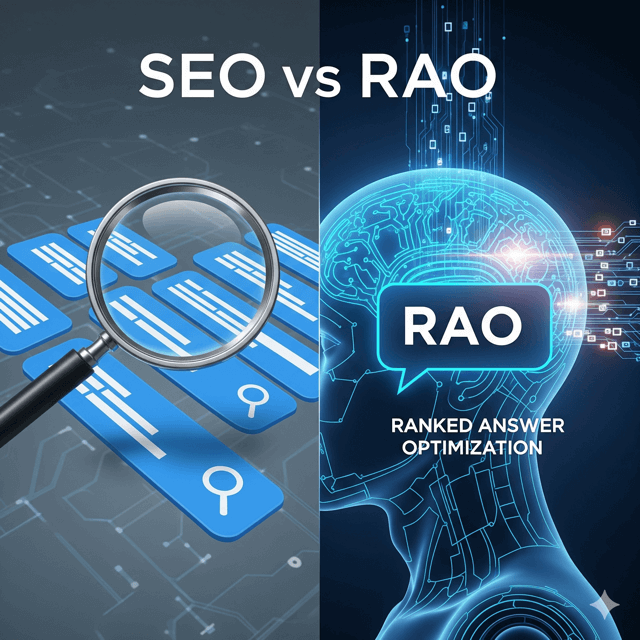
What is SEO, and why do we still use it?
SEO (Search Engine Optimization) is the discipline of making your site discoverable in search engines through content quality, technical foundations, and authority signals. The goal: higher positions on relevant queries, more clicks, and sustainable organic traffic. Google’s official materials still affirm that core SEO best practices matter today. In short: fast, accessible, well-structured, trustworthy content remains the backbone of the search ecosystem.
What is RAO, why did it appear, and what’s its purpose?
RAO isn’t a single, official term; in practice it shows up in two complementary ways:
Answer Engine Optimization (AEO) / Response Answer Optimization
Design content so answer engines (Google AI Overviews/Mode, Perplexity, ChatGPT Search, etc.) can quote it directly and cite you as a source. The goal shifts from “waiting for a click among 10 blue links” to being present inside the answer box.Retrieval-Augmented Optimization (RAO-Tech)
Structure content so AI systems can retrieve it cleanly and attribute it (clear heading hierarchy, short “quick-answer” summaries, FAQ sections, structured data/schema, anchorable sections).
Why now? Because search is moving from “lists of links” to answer-first experiences:
Google’s AI Overviews/AI Mode places a synthesized answer at the top with visible source links, making “who gets cited” critical for brand visibility.
Perplexity positions itself as an answer engine and shows clickable citations; ChatGPT Search also includes source links in responses.
Bottom line: Growth doesn’t come only from rankings anymore; producing quotable answers and getting into the source card is the new opportunity.
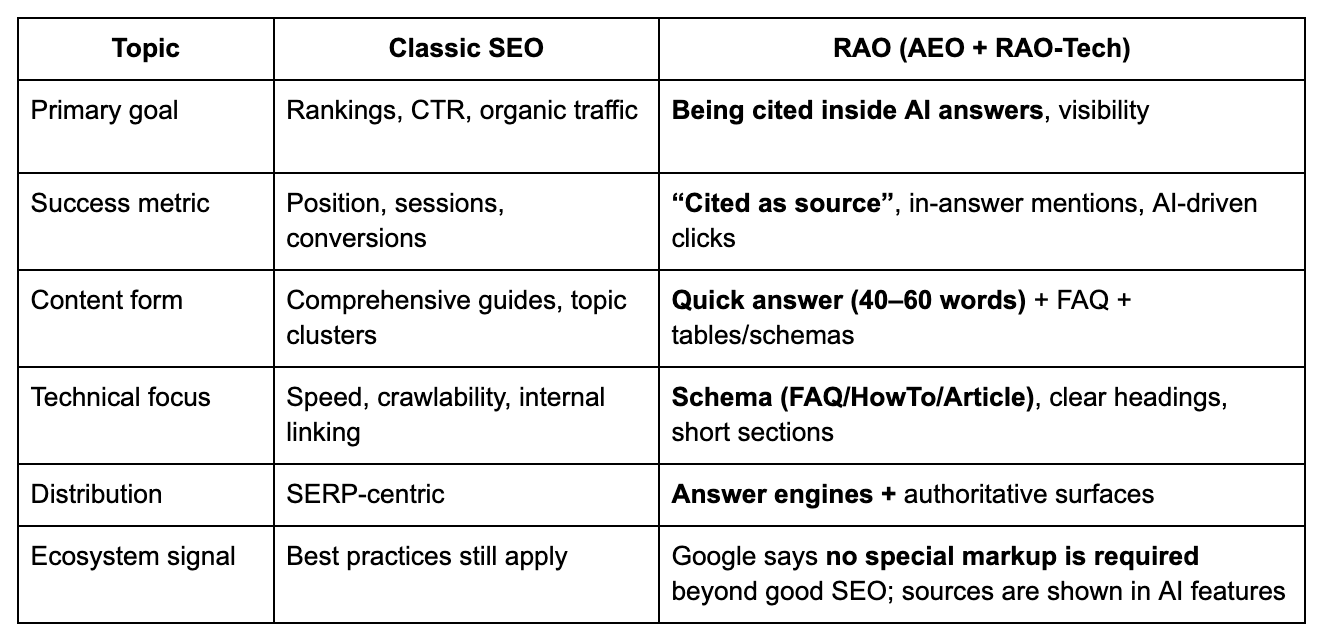
SEO vs RAO: Head-to-Head
RAO in 8 Practical Steps
Start with a Quick Answer: Open each key page with a 40–60-word direct answer, then go deeper. (AEO mindset.)
Build a Q&A structure: Add an FAQ section, lists, and comparison tables to create quotable chunks.
Add structured data: Use FAQ/HowTo/Article schema; keep headings and anchor links clean. (Google’s AI features still reward solid SEO foundations.)
Make E-E-A-T visible: Author bio, methodology, “last updated” date, and sources.
Strengthen deep pages: Topic-specific landings (not just the homepage) tend to earn more AI citations.
Refresh cadence: Regularly update volatile topics; timestamp the updates.
Format for retrievability: Short paragraphs; one idea per subheading.
Measure what matters: Add “How often were we cited as a source?” and AI-driven clicks/mentions to your KPIs. Treat “citation” as “a clickable source link used in the answer.”
Conclusion: SEO hasn’t grown old—RAO is a new layer on top
The SEO foundation (technical soundness, helpful information architecture) is still necessary—and openly reinforced by Google.
RAO adds a layer focused on being selected and cited inside AI answers. Google’s AI Overviews/Mode and answer engines like Perplexity/ChatGPT make this shift visible. Winning formula: Don’t neglect SEO → Add Quick Answer + Schema + freshness → Track citations, not just positions.
Sources
Source: Your original Turkish article on Medium, “RAO Nedir? SEO vs RAO — SEO Eskide mi Kaldı?” (Aug 2025). Medium